What a star tracker is for
Every imaging satellite needs to know its attitude: its orientation in space. Without it, the satellite cannot point its camera at a target or say where a picture was taken.
Several sensors can measure attitude. Sun sensors and magnetometers are small and cheap, and reach tenths of a degree to a few degrees. Gyroscopes measure how fast the spacecraft is turning, and drift over time. A star tracker measures attitude directly against the fixed stars, to arcseconds, which makes it the reference the other sensors are corrected against.
Star tracker vs sun sensor, magnetometer and gyro
Most small satellites carry several attitude sensors and blend them. Each has a job the others do badly.
| Sensor | Measures | Typical accuracy | Limits |
|---|---|---|---|
| Star tracker | Full 3-axis attitude against the stars | Arcseconds | Blinded by the Sun, Earth or Moon in view; loses the sky in fast slews |
| Sun sensor | Direction to the Sun | About 0.1° to a few degrees | Useless in eclipse; one direction only |
| Magnetometer | The Earth's magnetic field vector | About 1° to a few degrees | Needs a field model; disturbed by on-board magnets |
| Earth horizon sensor | Direction to the Earth's centre | About 0.1° to 1° | One direction only; weaker in small sizes |
| Gyroscope | Rotation rate | Precise over short times | Drifts; needs an absolute sensor to correct it |
Step 1: take a picture and find the stars
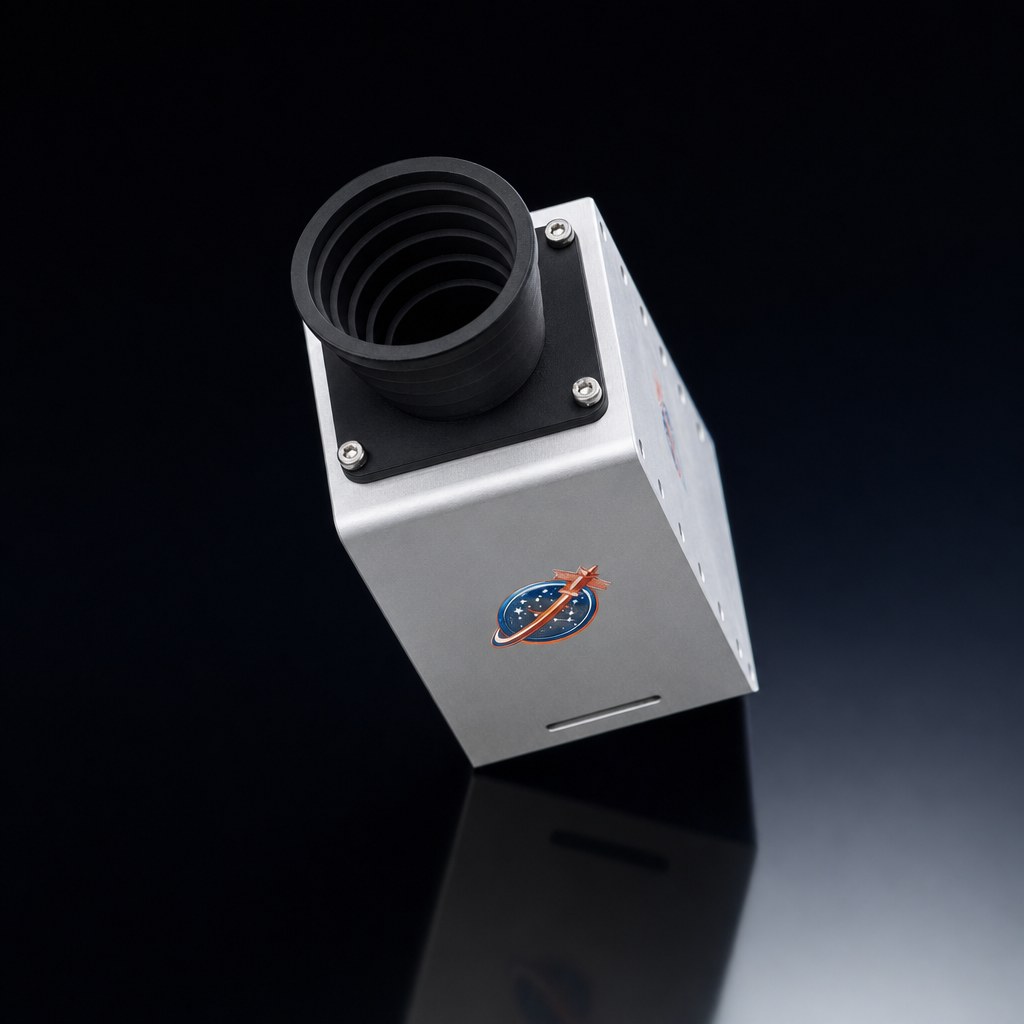
The tracker is a camera with a wide lens, a sensitive image sensor and a baffle that keeps sunlight and Earth glare out. It takes a short exposure of the sky.
Software then finds each star in the image and works out its centre to a fraction of a pixel. This step is called centroiding, and it sets the accuracy of everything after it. Stars are spread slightly over a few pixels on purpose, so the centre can be estimated from the brightness of its neighbours.
Step 2: work out which stars they are
The tracker carries a catalogue of stars and their positions. It measures the angles between the stars it sees and matches that pattern against the catalogue, much as you would recognise a constellation by its shape.
From a cold start with no prior knowledge, this is called lost-in-space identification and takes the most work. Once the tracker has a solution, it switches to tracking mode and only has to follow stars it already knows.
Step 3: solve for attitude
With each star identified, the tracker has pairs of directions: where the star appears in the camera, and where it sits in the sky. The rotation that best lines up every pair is the spacecraft's attitude. Finding it is a classic estimation problem, and trackers usually report the answer as a quaternion several times a second.
The attitude control system blends that with gyroscope rates in a filter, so the spacecraft always has a smooth, accurate estimate of where it is pointing.
Why fast slews break it
An agile satellite turns quickly between targets. During an exposure, every star then moves across the sensor and smears into a trail. The light that would have landed on a few pixels is spread along the whole trail, so faint stars sink into the noise and the centroid of a streak is hard to pin down.
Fewer usable stars means identification fails. A conventional star tracker loses the sky above about 3°/s, so agile satellites usually slew, wait, settle, and only then image. The same threshold appears in US export rules: star trackers that are accurate to 1 arcsecond and track at 3°/s or more are controlled under ITAR.
ITAR and fast star trackersKeeping the sky during a slew
One way through is to stop taking long exposures. Take a burst of short sub-frames instead, and use the measured rotation rate to register them on top of each other before adding them up. The starlight lands back in one point, while the noise grows only as the square root of the number of frames, so faint stars come back above the threshold.
That is how our star camera is designed to solve attitude while the spacecraft is still turning.