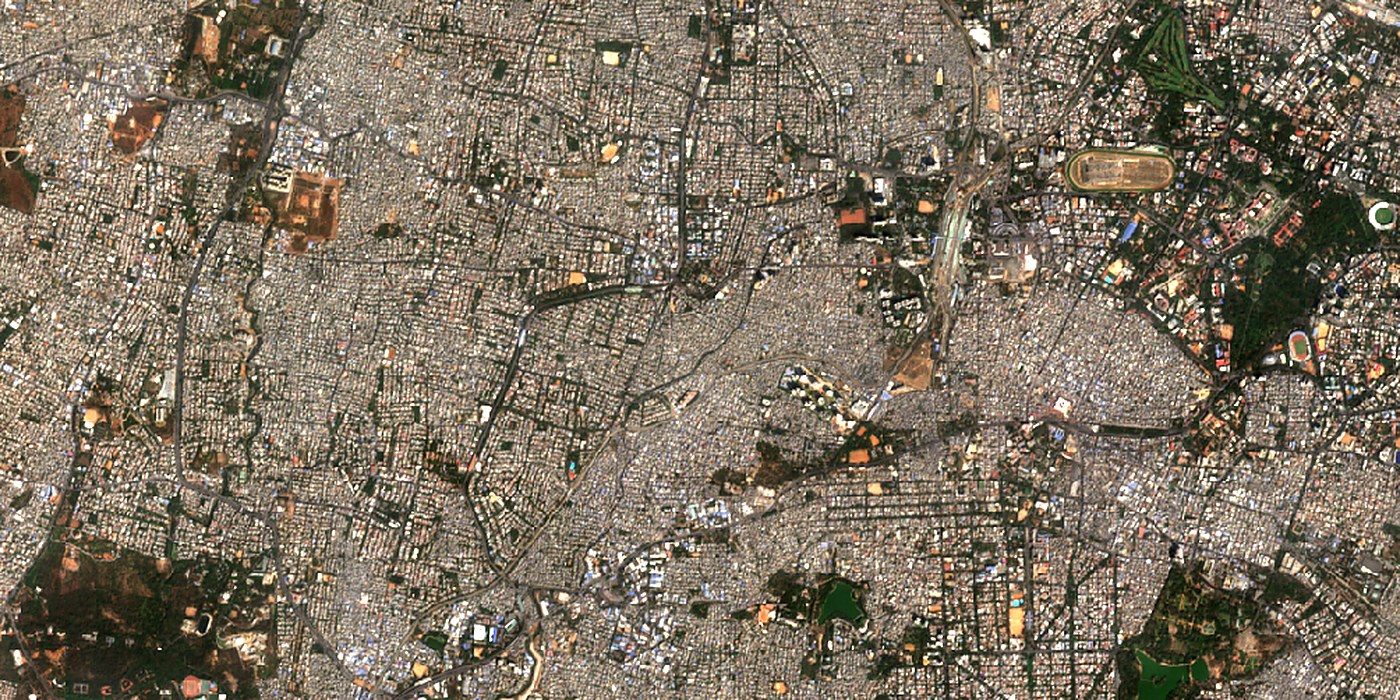
The GSD formula
Looking straight down, one pixel on the sensor covers a patch of ground whose width follows from similar triangles:
GSD = altitude × pixel pitch ÷ focal length
Keep the units consistent. A camera 500 km up, with 3.45 µm pixels behind a 600 mm lens, has a GSD of 500,000 m × 0.00000345 m ÷ 0.6 m ≈ 2.9 m. Halve the altitude or double the focal length and the GSD halves.
GSD calculator
Change any value. The swath is the width of ground one row of pixels covers. The diffraction spot is the smallest blur the aperture can form, projected onto the ground. The smear is how far the ground slides under the camera during one exposure, in pixels.
GSD vs resolution
GSD tells you how finely the sensor samples the ground. Resolution is the smallest detail you can see, and three things can make it worse than the GSD.
Diffraction. A lens of diameter D cannot focus light to a spot smaller than about 1.22 λ ÷ D radians. If that spot, projected to the ground, is bigger than a pixel, smaller pixels add data without adding detail. Set the aperture to 50 mm in the calculator and watch the diffraction spot outgrow the GSD.
Motion. In low Earth orbit the ground under a satellite moves at about 7 km/s. A 1 ms exposure lets the scene slide about 7 m, and any rotation of the satellite adds to that. Smear is the most common reason small-satellite images fall short of their GSD.
Optics and atmosphere. Lens aberrations, focus, detector crosstalk, haze and turbulence all soften the picture. Together they are measured as the modulation transfer function (MTF).
Why satellite images blurBalancing pixels against the lens
Engineers compare the diffraction blur with the pixel using a ratio called Q = λ × focal length ÷ (aperture × pixel pitch). Around Q = 1 the pixels and the lens are roughly balanced. Well below 1, the sensor limits detail and aliasing appears. Well above 2, the lens limits detail and the extra pixels mostly add data volume.
GSD at a few focal lengths
For a 500 km orbit and 3.45 µm pixels, looking straight down:
| Focal length | GSD | Swath (4,096 px) |
|---|---|---|
| 100 mm | 17.3 m | 70.7 km |
| 300 mm | 5.75 m | 23.6 km |
| 600 mm | 2.88 m | 11.8 km |
| 1,000 mm | 1.73 m | 7.07 km |
| 2,000 mm | 0.86 m | 3.53 km |
Looking off to the side
Tilt the camera away from straight down and the ground is further away and seen at a slant. For moderate angles the GSD grows roughly as 1 ÷ cos θ in one direction and 1 ÷ cos² θ in the other, where θ is the off-nadir angle. At 30° off nadir, pixels are about 15% and 33% larger. That is why operators quote a nadir GSD and an off-nadir range.
Getting the resolution the GSD promises
Short exposures stop the smear but collect less light. Our payload is designed to take many short sub-frames, register them using the star camera's attitude and stack them on board, so the picture keeps the sharpness of a short exposure and the signal of a long one.