What “U” means
A CubeSat unit, written U, is a 10 cm cube. The CubeSat Design Specification (CDS), kept by the CubeSat Program at Cal Poly, defines a 1U as 100 × 100 mm in cross-section and 113.5 mm long along its rails, with a mass of up to 2 kg. The rails run a little past the 10 cm body at each end, and those rail ends are where one CubeSat touches the next inside the dispenser.
Larger sizes stack units. A 3U is three units in a row. A 6U puts two 3U columns side by side, and a 12U puts four together.
CubeSat dimensions and mass, by size
The table gives the outer envelope along the rails and the typical maximum mass for each standard size.
| Size | Outer dimensions (mm) | Max. mass | Typical use |
|---|---|---|---|
| 1U | 100 × 100 × 113.5 | 2.00 kg | Education, technology demonstrators |
| 1.5U | 100 × 100 × 170.2 | 3.00 kg | Demonstrators that need a little more room |
| 2U | 100 × 100 × 227.0 | 4.00 kg | Small science and radio payloads |
| 3U | 100 × 100 × 340.5 | 6.00 kg | The workhorse: imaging, IoT, science |
| 6U | 100 × 226.3 × 366 | 12.00 kg | Larger optics, propulsion, commercial imaging |
| 12U | 226.3 × 226.3 × 366 | 24.00 kg | Large payloads and capable constellations |
The rules that come with the size
The size is only part of the standard. A few rules shape every CubeSat, whichever size it is.
Rails. The four long edges are rails that slide in the dispenser. Each must be at least 8.5 mm wide, measured from the edge of the rail to the first protrusion.
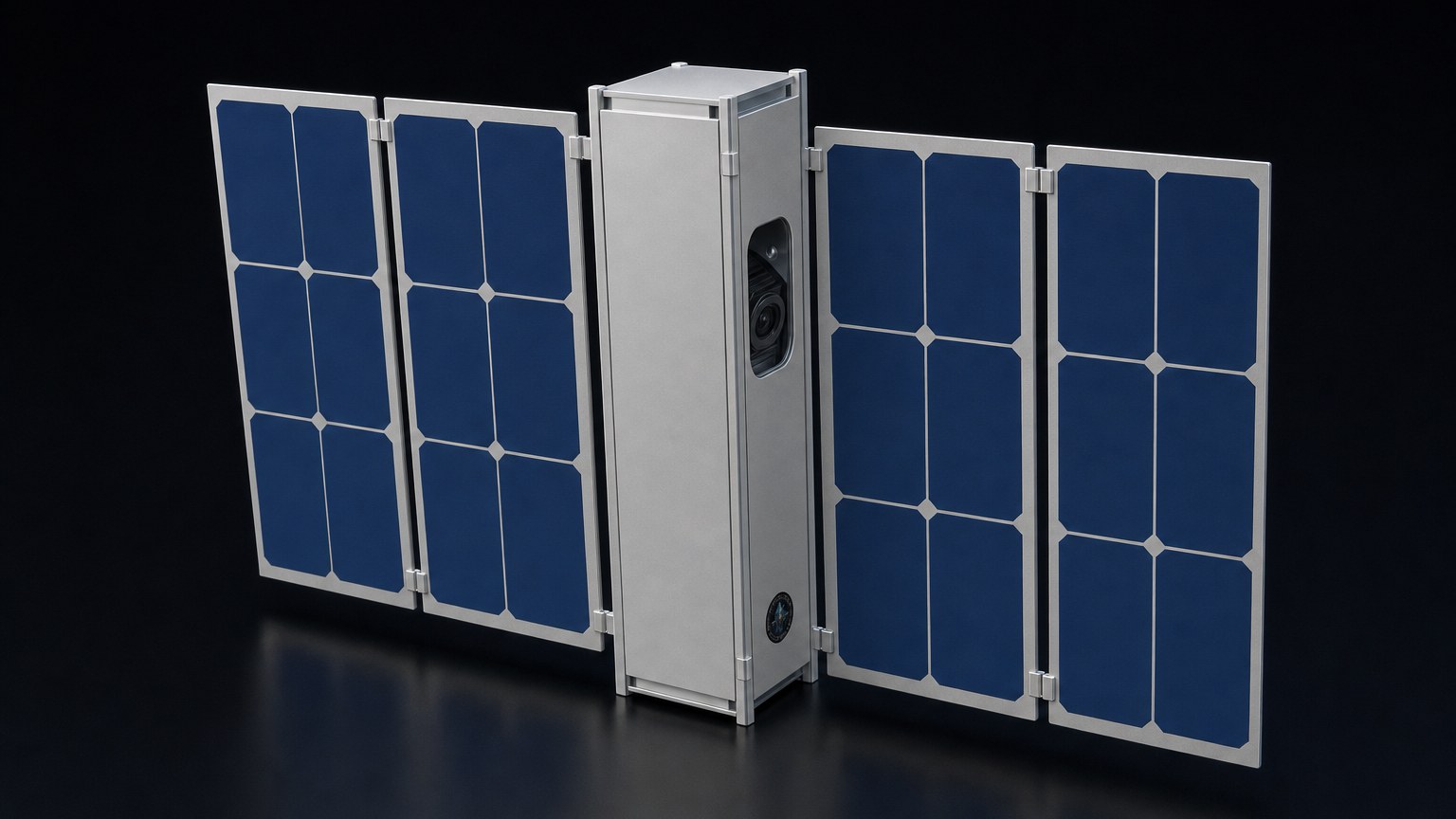
Protrusions. Nothing on the side faces may stand more than 6.5 mm out from the plane of the rails. That limit is why solar wings and antennas fold flat against the body.
Deployables. Wings and antennas must be held closed by the CubeSat itself, never by the dispenser door.
Centre of gravity. For a 1U, the centre of gravity must sit within 2 cm of the geometric centre on every axis. Longer sizes allow a little more along the long axis.
Mass is a guideline; the dispenser decides
Revision 14 of the CDS turned many hard requirements into guidelines. The mass table gives typical maximums, and heavier satellites are judged mission by mission. The limits that bind you are the ones in your dispenser's interface document, so read it before you freeze a design.
Inside is smaller than outside
The walls, rails and fasteners take their share, so the usable volume is noticeably smaller than the outer envelope. Most CubeSat electronics use boards of about 90 × 96 mm, the PC/104 footprint, stacked along the long axis. Optics, reaction wheels and batteries compete with that stack for the same space.
In our 3U design, for example, the bus sits above a divider and leaves a payload bay of about 1.7U below it.
The 3U CubeSat busHow to choose a size
Start from the payload. An imaging payload needs aperture, and the aperture limits the detail you can resolve from a given orbit. It also needs power, downlink and pointing, and each of those takes volume in the bus.
A 1U is enough to prove a technology in orbit. A 3U can carry a real imaging payload with three-axis pointing. A 6U or 12U buys larger optics, more solar area and room for propulsion.