A star tracker that keeps its fix while the satellite turns.
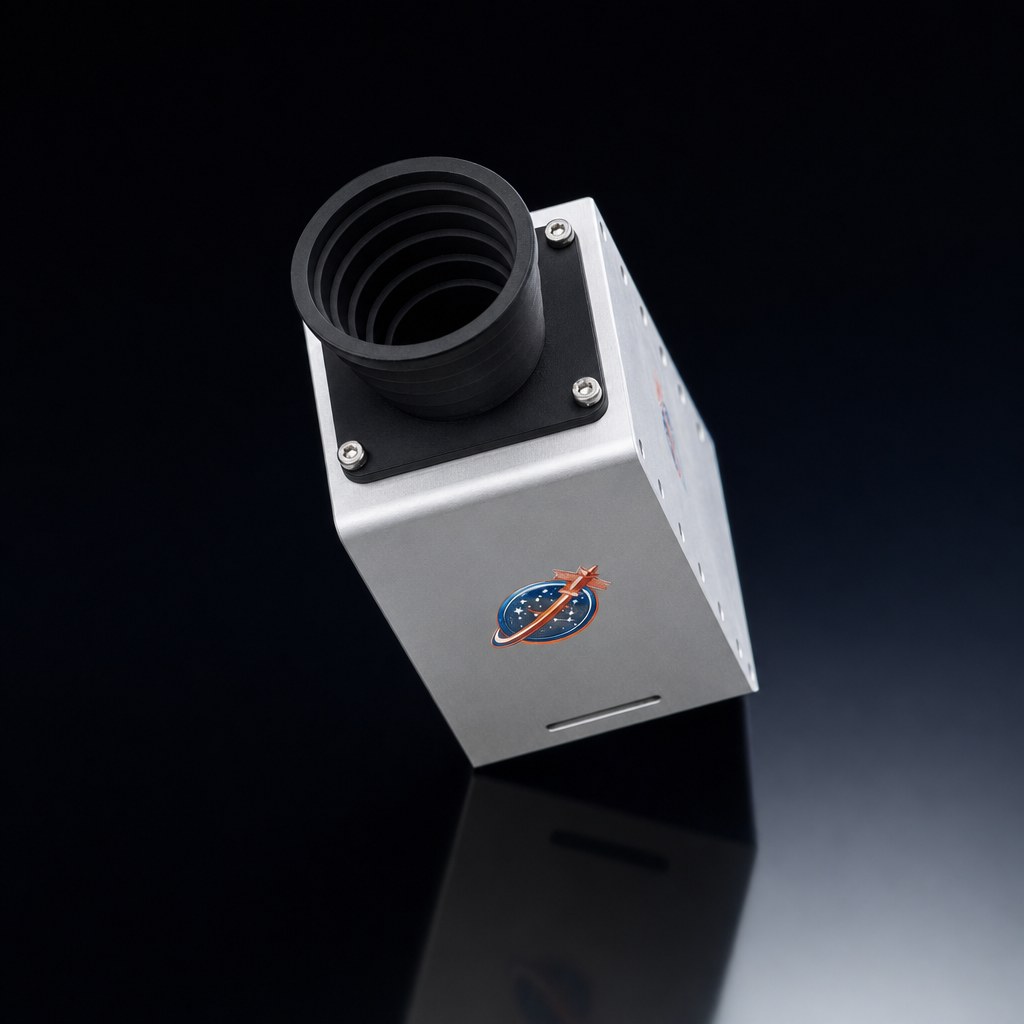
Our star camera is a star tracker for agile small satellites. It solves attitude mid-slew, and that solution becomes the prior our imaging chain uses to stack its own sub-frames on board. The satellite can image without stopping to settle.
Fast slews blind a conventional star tracker.
Above about 3°/s, a conventional tracker can no longer hold the sky. During a long exposure each star smears into a trail, the faint ones sink into the sensor's noise, and the tracker is left with too few stars to match against its catalogue.
The usual workaround is to stop: slew, wait for the tracker, settle, and only then image. Each of those waits is time spent over the ground with nothing being collected.
Short exposures, registered on board.
The star camera replaces one long exposure with a burst of short sub-frames and registers them using the measured rotation as a prior. Photons that a long exposure spreads along a trail land back in a single point, while the noise grows only as the square root of the number of frames.
Faint stars come back above the detection threshold, and the camera can solve attitude mid-slew.
Simulation of a stylised frame at 14°/s. A single 100 ms exposure leaves 93 px trails and 3 stars above threshold; a 20 × 5 ms registered stack detects 11.
What changes when the payload carries the precision.
- No settling wait
- The satellite can move to its next target and start imaging while still turning.
- Attitude feeds the imager
- The star camera's solution is the prior the imaging and compute chain uses to register and stack its sub-frames. The result is a sharp, geolocated tile with metadata attached.
- Any bus
- The precision lives in the payload, so a CubeSat or small satellite with ordinary pointing still returns sharp pictures.
- ITAR-free
- Designed and built in India, so it is not a US defence article under ITAR.
Flying on Stratos-2 in October 2026.
The star camera flies on Stratos-2, our second stratospheric flight, in October 2026. Its measured performance will be published here after that flight. We publish a number once it has flown.
Engineering units can be reserved now for 2027.
Star tracker FAQ
What does a star tracker do on a satellite?
It photographs the stars, identifies them against an on-board catalogue and works out which way the spacecraft is pointing. It is usually the most accurate attitude sensor a small satellite carries.
What slew rate can a conventional star tracker handle?
About 3°/s before it loses the sky. That limit is why agile satellites usually stop and settle before they image.
How is a star camera different from a star tracker?
Both solve attitude from the stars. Ours takes short sub-frames and registers them on board, so it keeps a solution while the spacecraft is still slewing and shares that attitude with the imaging chain.
Is it suitable for CubeSats?
It is designed for small satellites, and our own reference design is a 6U. Ask the team for interface details.
When will specifications and pricing be published?
Specifications follow the Stratos-2 flight in October 2026. We only publish figures that have flown. For pricing, reserve an engineering unit and the team will reply.
Is the star tracker ITAR-free?
Yes. It is designed and built in India and is ITAR-free.
Fly a pathfinder.
Reserve a star-camera engineering unit for 2027.